
MIND & BODY
SHAKING
the rust
As the seasons change, GAVIN GROVES tell us, in part one of a two-issue series, not to try and go from hibernation to full speed
DR KIRSTEN VAN HEERDEN
Part 1
last month we discussed winter warm-ups
REad IT HERE

Spring is here, the days are getting longer and, for many golfers, thoughts are already turning towards summer golf. After a winter of fewer rounds, less time outdoors and perhaps a little less time in the gym, the temptation is to make up for lost time.
Unfortunately, your body doesn't work that way. One of the biggest mistakes I see when golfers return to training after a quieter winter is trying to do too much, too soon. The motivation is there, but the physical capacity to handle the workload may not be.
The answer isn't to avoid training, but to start intelligently.
1 Establish where you are
Before deciding what you need to train, establish where you are starting from. As Dr. Greg Rose, a sports biomechanics expert and chiropractor who co-founded the Titleist Performance Institute (TPI), said: 'If you aren't testing, you're guessing'. A good golf-specific assessment should give you a snapshot of your current physical capacity and identify any restrictions or weaknesses that could influence your golf swing.
This might include looking at:
- Hip and thoracic spine mobility
- Shoulder and ankle mobility
- Balance and stability
- Core and pelvic control
- Strength and force production
- Power and movement speed
- General fitness and conditioning
- Previous or recurring problem areas
The important point is that there isn't a single 'best' training programme for every golfer.
One golfer may have plenty of strength but lack rotational mobility. Another may move well but lack the strength to control those positions. Someone else may have a good physical foundation but lack the power and speed required to transfer it into the golf swing.
The assessment should determine what you train, rather than simply confirming that you need to train.
2 No quick 'fix'
Once you've identified your limitations, the next temptation is to attack all of them simultaneously. That's another common mistake I see in the fitness world. Your training should have a priority.
If restricted hip mobility is affecting your ability to rotate, that needs attention. If you lack the strength to control your lower body, build that foundation. If you already have good mobility and strength, your programme may need to focus more heavily on power and speed.
The goal isn't to become exceptionally good at every physical quality. It is to improve the qualities that will have the greatest impact on your golf.
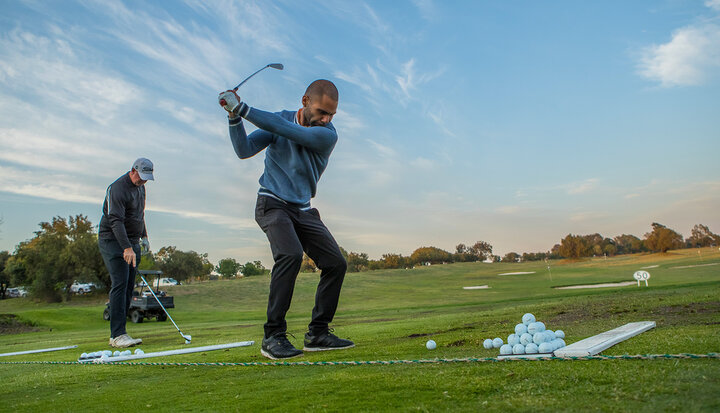

Golf is good for strength – and more
There are many types of fitness, and no one 'type' of exercise should be seen as all you need to do.
For example, cardio should be combined with some strength training. We all know a round of golf is great good low-intensity cardiovascular exercise, but does that mean we need to hit the gym for some weight training as well?
Not so, according to devereuxgolf.com: 'It is recommended that all adults complete at least two to three strength-building exercise sessions per week. When you swing a golf club, you don't just use your arms and shoulders. You also engage the muscles in your back and core and rely on your legs. This means you get a tiny full-body workout with every swing.'
The popular golf blog contintues: 'Many people ask, 'Is hitting golf balls good exercise?' From a strength-training perspective, the answer is yes. Going to the driving range and hitting a couple of buckets of balls allows you to work out all your major muscle groups. The only thing missing from exercise at the range is the cardiovascular component. However, strength training carries health benefits on its own. It can:
- Make your muscles stronger and less susceptible to injury
- Improve your bone density as you age
- Increase your coordination and balance
- Enhance your mobility
'Getting into the habit of playing golf can help you maintain your muscle tone as you age, helping you remain strong and independent for longer.'
3 Build up your training gradually
Think of returning to training like building a golf swing: you don't go from hitting 20 balls to hitting 200 because you feel good on the first day. Your body needs time to adapt to increased training loads.
A sensible progression might look something like:
Reintroduce movement → build capacity → increase strength → develop power → train speed.
That doesn't mean you need to spend months doing basic exercises before progressing. For many golfers, two or three quality training sessions each week is a far better starting point than suddenly trying to train five or six days a week.
4 Soreness doesn't mean progress
There's a strange belief that if you're not sore after training, you haven't trained hard enough. That's not how effective training works.
Some muscle soreness is normal when returning after a period of inactivity, but excessive soreness can interfere with your golf, reduce movement quality and compromise your next training session. The objective is to create enough training stimulus to adapt, while still allowing your body to recover. You want to be able to train consistently next week – not just survive this week.
5 Start with a goal
Perhaps the most important part of a spring training programme is deciding what you actually want to achieve. Perhaps a good question to ask could be: What would make my golf better by the time summer arrives?
It might be:
- Increase driving distance
- Improve consistency
- Reduce fatigue over 18 holes
- Improve mobility
- Build strength
- Increase clubhead speed
- Become more resilient to injury
- Simply feel better physically on the course
Once you have a goal, your assessment and training programme can work backwards from that. That makes training purposeful rather than simply exercising for the sake of exercising.
The biggest mistake is thinking that you have to become 'golf fit' in the next six weeks. You don't.
The best time to start preparing for summer golf is now, because the physical adaptations you want – strength, mobility, power, speed and conditioning – take time to develop.
Spring shouldn't be about trying to undo everything that happened over winter. It should be about building the foundation for the season ahead. So before you jump straight back into five gym sessions a week and start chasing your summer swing, take a step back.
Assess where you are. Identify what you need. Set a goal. Then build progressively towards it.
About the author
Gavin Groves graduated in biokinetics from the University of Pretoria in 2007 and started working as a golf fitness professional at the World of Golf. A year later, he started his journey with the Titleist Performance Institute. He is also an AA-member of the PGA of South Africa. He joined the University of Pretoria's High Performance golf programme in 2013. In 2018, he moved to the DP World Tour, while he also counts numerous past and present Sunshine Tour professionals as clients. He has been the full-time fitness consultant of the GolfRSA National Squad since 2017 and worked with some of the best SA amateur golfers.
Gavin Groves graduated in biokinetics from the University of Pretoria in 2007 and started working as a golf fitness professional at the World of Golf. A year later, he started his journey with the Titleist Performance Institute. He is also an AA-member of the PGA of South Africa. He joined the University of Pretoria's High Performance golf
Gavin Groves graduated in biokinetics from the University of Pretoria in 2007 and started working as a golf fitness professional at the World of Golf.
A year later, he started his journey with the Titleist Performance Institute. He is also an AA-member of the PGA of South Africa. He joined the University of Pretoria's High Performance golf
programme in 2013. In 2018, he moved to the DP World Tour, while he also counts numerous past and present Sunshine Tour professionals as clients. He has been the full-time fitness consultant of the GolfRSA National Squad since 2017 and worked with some of the best SA amateur golfers.

About the author
Dr Kirsten van Heerden represented South Africa at swimming and holds a PhD in sport psychology. She has worked and travelled extensively within high performance sport for more than 15 years. She has authored a book, Waking From the Dream, on the challenges athletes face when they retire from elite sport. In her podcast ‘Behind the Dream’ she talks with some of the world’s best athletes about the ups and downs of being a professional athlete. She is also the founder and chairperson of Girls Only Project – a non-profit company focusing on women in sport issues. She is in private practice at Newton Sports Agency.




About the author
Dr Kirsten van Heerden represented South Africa at swimming and holds a PhD in sport psychology. She has worked and travelled extensively within high performance sport for more than 15 years.She has authored a book, Waking From the Dream, on the challenges athletes face when they retire from elite sport. In her podcast ‘Behind the Dream’ she talks with some of the world’s best athletes about the ups and downs of being a professional athlete. She is also the founder and chairperson of Girls Only Project – a non-profit company focusing on women in sport issues. She is in private practice at Newton Sports Agency.
Dr Kirsten van Heerden represented South Africa at swimming and holds a PhD in sport psychology. She has worked and travelled extensively within high performance
sport for more than 15 years.She has authored a book, Waking From the Dream, on the challenges athletes face when they retire from elite sport. In her podcast ‘Behind the Dream’ she talks with some of the world’s best athletes about the ups and downs of being a professional athlete. She is also the founder and chairperson of Girls Only Project – a non-profit company focusing on women in sport issues. She is in private practice at Newton Sports Agency.

SHAUN ROY | TYRONE WINFIELD | SUNSHINE TOUR