
WHERE ARE THEY NOW?
Ben
Fouchee
The next in our series of popular catch-ups with a household name on the Sunshine Tour from yesteryear
BY MIKE GREEN
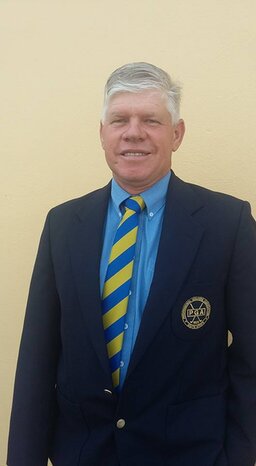
With a Hall-of-Famer on his bag at Royal Porthcawl in 1988, Ben Fouchee once famously came within a stone's throw and an agonising three-putt of playing in the Masters and the Open Championship.
Fouchee, himself a winner of the South African Amateur Stroke Play Championship and the South African Amateur Championship in 1987 – a rare double – had Ernie Els as his roommate in Wales as four South Africans made the journey to play in the Amateur Championship in 1988.
'The other two guys were Neville Clark and Ian Hutchings,' remembers Fouchee. 'We travelled together as a team, and, in the apartheid years, that was like one of the only international tournaments that we could play as amateurs. So we couldn't show anything that we were from South Africa, and we were basically there as individuals. All the other countries' players were wearing their team colours, and you could see where they were from.
'Ernie and I both made it through to the match play, and he dropped out in the fourth round. The arrangement was that the one that drops out caddies for the other. So he caddied for me in the quarters.
'And then in the semi-finals, I played against the guy who beat Ernie, and I beat him in a play-off. In the finals, I played against a Swedish guy, Cristian Härdin, and then I lost the 36-hole final on the last hole.
'I won the 34th hole to go one up, and as we were walking up to the 17th tee-box, Ernie said to me, "Benny, just remember one thing, if you win this thing, and you play in the Masters, I'm your caddie." Because you know, if you win the Amateur, you're going to the Masters and to the Open. And I said to myself, "no, no, no, I must first finish this."'
'(As a pro) you're trying to survive, you're thinking about making cuts, you're thinking about making money, and that's where it all changes'
AS A PLAYER
Reached a career high 262nd in the world
Won twice on the Sunshine Tour – the 1988 Kalahari Classic and the 1989 Transvaal Classic, and was Rookie of the Year in 1988
Finished 7th on the 1993/94 Sunshine Tour Order Of Merit
Achieved 26 consecutive cuts and 35 top 10 finishes on the Sunshine Tour
Fouchee put his blind tee-shot on the 17th down the right-hand side of the fairway, and his opponent hooked his into the left rough. The South African duo thought they were on their way to Augusta. But Fouchee's ball had run just a foot off the fairway, and there was a stone right behind it. Moving it would have caused his ball to move.
'There wasn't another stone within 50 metres,' Fouchee says. 'My opponent had a good lie on a service road, and he hit his second close to the green to make birdie. I could only roll my ball down the fairway, and I couldn't get close enough with my third, so I only made par for him to level the match.
'Then I three-putted the last, with my second putt lipping out from about one-and-a-half feet. To this day, when Ernie sees me, he says, "You should have won, you should have beaten that guy, I can't believe what happened to you on the second putt."'
But Fouchee recognises that regrets are fruitless. 'Golf has been in my blood all my life, so that's why I always wanted to be a pro golfer,' he says, 'and when that didn't work out, the next route was still to be involved in the game. And that's how I decided to go into the teaching and the coaching.'
'When I won Rookie of the Year in 1988, there was someone who was willing to sponsor me to go to the European Tour School in Spain, but we couldn't travel,' he recalls. 'If I had turned pro five or six years later, things might have been different.
'When you're an amateur, there's only one thing that counts, and that's winning tournaments. Then when you turn pro, all of a sudden, you also play to win tournaments. But quickly, it changes because now you're making a living out of it, and then if you miss a cut, you're not getting any money.
'The focus shifts, you know? The focus is not always on winning like it used to be. Now you're trying to survive, you're thinking about making cuts, you're thinking about making money, and that's where it all changes.
'So I think they don't always prepare you for that. When you turn pro, a lot of the young golfers, physically their game is good enough to shoot low scores, and to do well in tournaments. But they don't prepare you for the mental pressures of professional golf, and I think that's a big thing.'
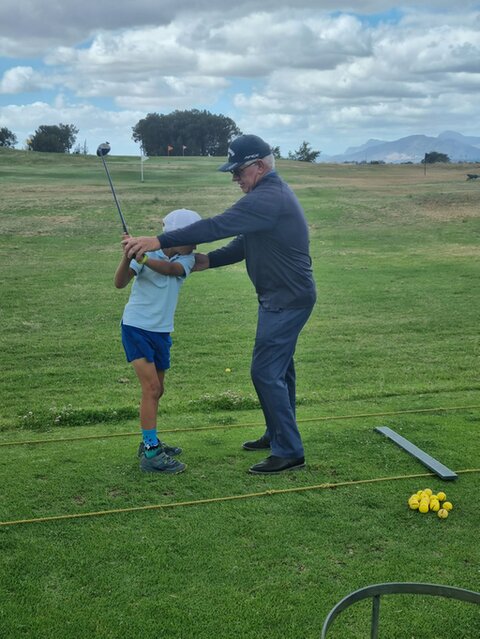
Stopping the touring life meant he had some hard decisions. 'I decided if I was going to stop, I was going to get involved in coaching, and I moved down to Cape Town. And I've been down here ever since, at Paarl Golf Club now for 30 years, after three years at a driving range in Durbanville.
'I see other guys, they go from one club to the other, but I've always been quite happy here and I've been doing quite well, so I didn't see a need to go somewhere else. Sometimes you think to yourself, it's time for a change of scenery, but I don't know, maybe that day will come…'
The truth is it won't come. He's too good at what he does where he is. 'Some people, they want to teach golfers who will become famous, and that's never been a dream of mine,' he says. 'I teach people, and if they're good and they manage to become professionals or top amateurs, then great, I'll help them as far as I can. But I have just as much passion to teach a beginner golfer just to be able to make contact with a golf ball, and, you know, just see average people start off.
'Some people, when they're 70 years old, they only start with golf, and little children now, they eventually become nice golfers, and I love to impart that love for golf.'
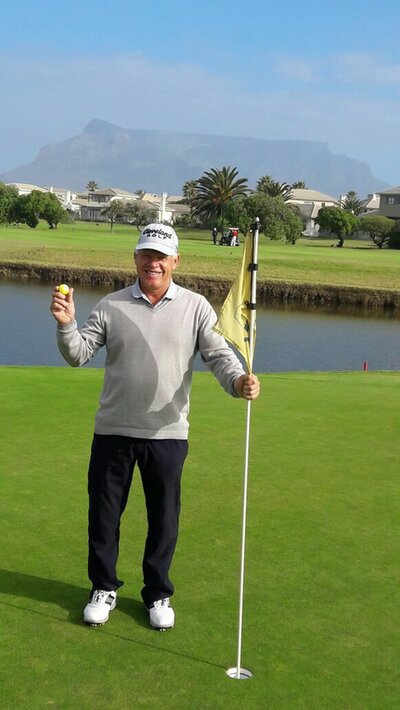
There is a palpable sense of a golf-life-well-lived about Fouchee. And it's confirmed by the relish with which he tells of the 1000 cases of Bell's whisky he won for a hole-in-one at Mowbray Golf Club in the Bell's Cup in 1991.
'The whisky was finished a long time ago,' he says. 'I don't drink whisky, otherwise I would have had a few cases left still. So I got rid of the stuff.
'With brandy, it would have been a different story.'
BF GOLF ACADEMY | INSTAGRAM.COM | FACEBOOK.COM