
MIND & BODY
MOOD
swings
It's not just opinion, it's fact: Golf is good for your state of mind and well-being, and here's why
DR KIRSTEN VAN HEERDEN
Part 1
last month we discussed winter warm-ups
REad IT HERE

There is an old line golfers love to use: 'A bad day on the golf course beats a good day in the office.'
Like most good clichés, it survives because there is some truth in it. But it is also worth asking why. Why does a frustrating round – missed putts, bad lies, lost balls and all – still often leave people feeling better than when they arrived?
The answer is not simply that golf is relaxing. Anyone who has stood over a three-foot putt to win a round know this! In fact, golf can be pretty frustrating.
And yet, for many people, golf genuinely does improve mood.
From a psychological point of view, golf is interesting because it brings together several ingredients that we already know are good for human well-being: movement, daylight, nature, attention, challenge and social connection.
It gets you moving
Golf gets the body moving – it is not passive recreation. It may not be a gym session, but that's part of its value. It is activity disguised as play.
Movement has a well-established effect on mood, partly because it changes the body's stress chemistry and partly because it gives the brain a different job to do. This is one of the reasons people often feel mentally clearer after playing. It is not magic. It is physiology.
There is also something important about the fact that this movement happens in sunlight:
- Exposure to daylight helps regulate our circadian rhythm – the internal timing system that influences sleep, energy, alertness and mood.
- Longer wavelengths of sunlight, including red and near-infrared light, seem to have a positive effect on mitochondrial function. Mitochondria are the energy-producing structures of our cells, and healthy mitochondrial function is increasingly being linked to energy regulation, slower ageing and overall health.


Mood Booster on the Fairway
Exercising outdoors has been proven to boost your mood, while stimulating your mind, which helps relieve anxiety and depression.
'Whether you plan on walking nine or 18 holes, or ride in a cart, just being outside in the fresh air and under the sunshine does a lot to your overall mood. So don't take that for granted, even if you're slicing the ball all over the course.'
Golf offers a unique combination of gentle exercise, time in nature and positive social interaction – all proven ingredients for improving your mood. Walking the fairways increases the release of endorphins, the body's natural 'feel-good' chemical, while spending time in green spaces can help reduce everyday stress and mental fatigue.
Unlike many forms of exercise, golf also encourages mindfulness. Focusing on each shot helps shift your attention away from daily worries and into the present moment. Add in the camaraderie of playing with friends, and it's easy to see why golfers often leave the course feeling happier than when they arrived.
Sometimes the best medicine is simply a walk with a golf club in hand.
Walking helps thinking
Golf creates a particular kind of mental movement. As we walk down a fairway, our visual world moves with us. In neuro-science, this is known as optic flow – the pattern of movement across our field of vision as we move through space. There seems to be something psychologically useful about this. Many people find that they think better while walking. Problems loosen. Thoughts organise themselves. The mind feels less stuck. Part of this may be because walking forward gives the brain continuous information that we are moving through the world rather than sitting still inside a problem. The fairway gives us literal forward movement, and sometimes that helps create mental forward movement too.
That is one of golf's under-rated gifts. You hit a shot, you move. You make a mistake, you move. You feel frustrated, but you keep walking. The game does not allow you to stay completely frozen in one moment.
Golf controls our attention
Golf controls attention. When you stand over a shot, you can't think about ten things at once and play well. The game pulls you back to the present moment and gets you out of your head. It can help quieten the mind for a few hours.
The game also gives the brain a reward loop. Dopamine is often described too simply as the 'pleasure chemical', but it is better understood as being linked to motivation, reward, anticipation and learning. Golf offers all of that. You are constantly solving problems, adjusting, receiving feedback and chasing the next small moment of mastery.
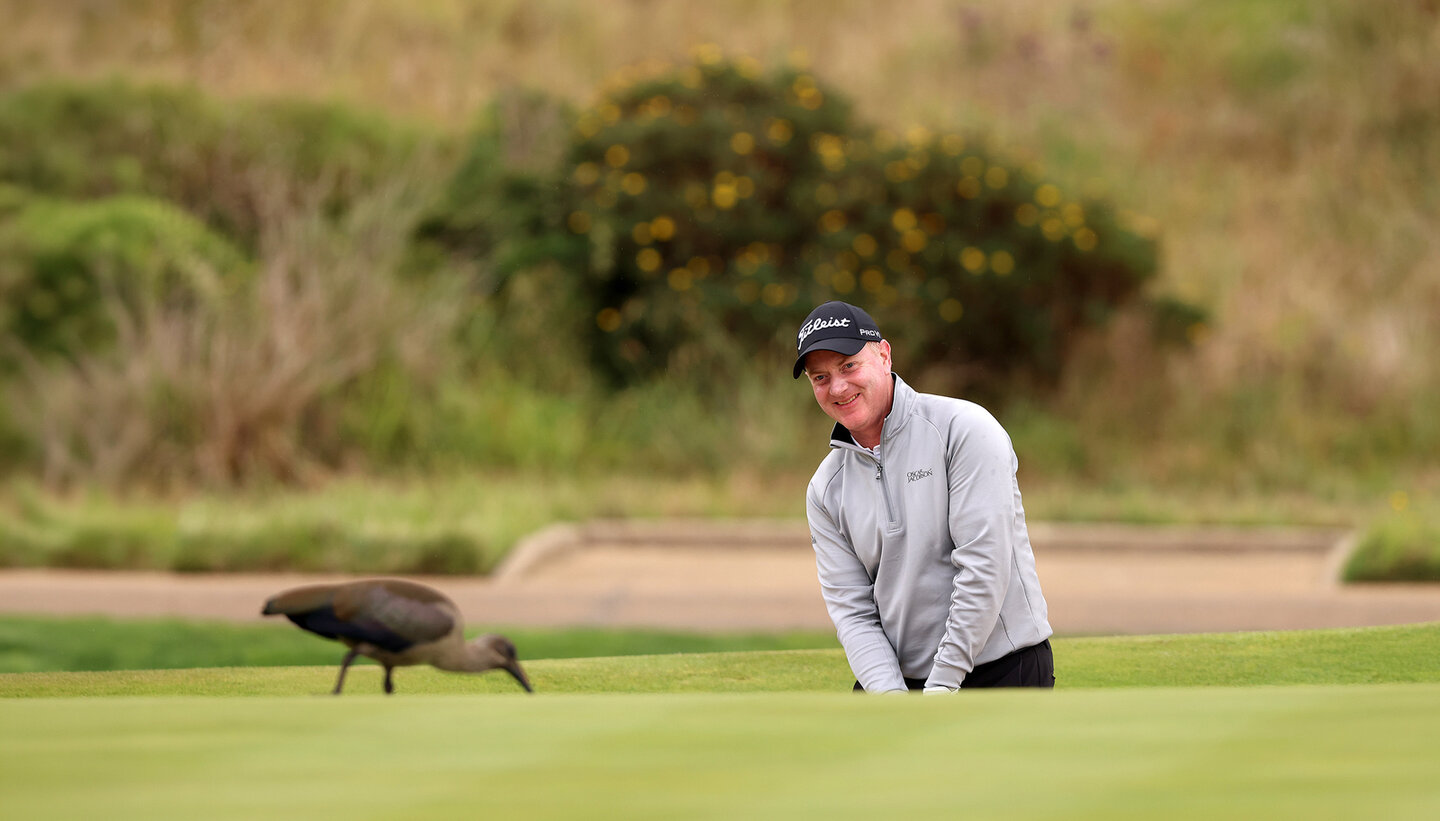
Golf is Social
Golf is also social in a way many adult activities are not. You can walk with someone for four hours. conversation comes and goes, silence is acceptable, jokes are easy, competition is fun. For many people, this kind of side-by-side connection is very valuable. It allows companionship without pressure.
Golf teaches us new skills
Golf can improve how we function off the course because it trains emotional skills that transfer into daily life: the game asks us to recover from mistakes quickly, to manage frustration and make decisions under pressure. It asks us to accept what has already happened and commit to the next shot anyway. These are not just golf skills. They are life skills.
A player who can hit a poor drive, take a breath, choose a sensible recovery shot and stay engaged is practising something far bigger than course management. They are practising emotional regulation. They are learning not to let one mistake become a mood, and not to let one bad hole become a story about the whole round.
Of course, golf can also hurt your mood if you approach it badly. If every round becomes a judgement of your worth, if every mistake becomes self-criticism, if every scorecard becomes evidence that you are failing, then golf stops being good for your mood and becomes another arena for pressure.
The difference is not the game. The difference is how we relate to the game.
So yes, golf is good for your mood. And perhaps that is why even a bad day on the golf course can beat a good day in the office: because sometimes, what improves our mood is not escaping difficulty. It is meeting difficulty in a better place.
About the author
Gavin Groves graduated in biokinetics from the University of Pretoria in 2007 and started working as a golf fitness professional at the World of Golf. A year later, he started his journey with the Titleist Performance Institute. He is also an AA-member of the PGA of South Africa. He joined the University of Pretoria's High Performance golf programme in 2013. In 2018, he moved to the DP World Tour, while he also counts numerous past and present Sunshine Tour professionals as clients. He has been the full-time fitness consultant of the GolfRSA National Squad since 2017 and worked with some of the best SA amateur golfers.
Gavin Groves graduated in biokinetics from the University of Pretoria in 2007 and started working as a golf fitness professional at the World of Golf. A year later, he started his journey with the Titleist Performance Institute. He is also an AA-member of the PGA of South Africa. He joined the University of Pretoria's High Performance golf
Gavin Groves graduated in biokinetics from the University of Pretoria in 2007 and started working as a golf fitness professional at the World of Golf.
A year later, he started his journey with the Titleist Performance Institute. He is also an AA-member of the PGA of South Africa. He joined the University of Pretoria's High Performance golf
programme in 2013. In 2018, he moved to the DP World Tour, while he also counts numerous past and present Sunshine Tour professionals as clients. He has been the full-time fitness consultant of the GolfRSA National Squad since 2017 and worked with some of the best SA amateur golfers.


About the author
Dr Kirsten van Heerden represented South Africa at swimming and holds a PhD in sport psychology. She has worked and travelled extensively within high performance sport for more than 15 years. She has authored a book, Waking From the Dream, on the challenges athletes face when they retire from elite sport. In her podcast ‘Behind the Dream’ she talks with some of the world’s best athletes about the ups and downs of being a professional athlete. She is also the founder and chairperson of Girls Only Project – a non-profit company focusing on women in sport issues. She is in private practice at Newton Sports Agency.




About the author
Dr Kirsten van Heerden represented South Africa at swimming and holds a PhD in sport psychology. She has worked and travelled extensively within high performance sport for more than 15 years.She has authored a book, Waking From the Dream, on the challenges athletes face when they retire from elite sport. In her podcast ‘Behind the Dream’ she talks with some of the world’s best athletes about the ups and downs of being a professional athlete. She is also the founder and chairperson of Girls Only Project – a non-profit company focusing on women in sport issues. She is in private practice at Newton Sports Agency.
Dr Kirsten van Heerden represented South Africa at swimming and holds a PhD in sport psychology. She has worked and travelled extensively within high performance
sport for more than 15 years.She has authored a book, Waking From the Dream, on the challenges athletes face when they retire from elite sport. In her podcast ‘Behind the Dream’ she talks with some of the world’s best athletes about the ups and downs of being a professional athlete. She is also the founder and chairperson of Girls Only Project – a non-profit company focusing on women in sport issues. She is in private practice at Newton Sports Agency.

TYRONE WINFIELD | EJ LANGNER | SUNSHINE TOUR