
MIND & BODY
Stay
COMPOSED
If you can keep your head while those around you are losing theirs, you'll be a winner
DR KIRSTEN VAN HEERDEN

Golf has always sold itself as the ultimate individual sport. One player. One ball. One scorecard. No one to blame, no one to carry you. Just you and your game. But that's not quite true.
Because while golf is scored individually, it is not experienced that way. Whether you realise it or not, your performance is shaped by the people around you. Not just by what they say or do, but by something far less obvious: the state they are in.
WHAT DOES STATE MEAN?
Your state is the condition your mind and body are in at any given moment – how calm, tense, focused, or unsettled you feel. It's not just about your thoughts. It's about what your nervous system is doing underneath.
On the course, this shows up in ways every golfer recognises:
- How relaxed or tight you feel over the ball
- Whether your thinking is clear or cluttered
- The rhythm and tempo of your swing
- How you respond after a poor shot
At any moment, you sit somewhere on a spectrum of composed and focused to tense and rushed, and where you are on that spectrum has a direct impact on how you play. But here's the part most golfers miss: That state isn't created by you alone.
Human beings are wired to read and respond to each other constantly. Long before we think, analyse, or make decisions, our nervous system is scanning the environment asking one question: Am I safe here?
And it doesn't answer that question in isolation. It uses other people as cues.
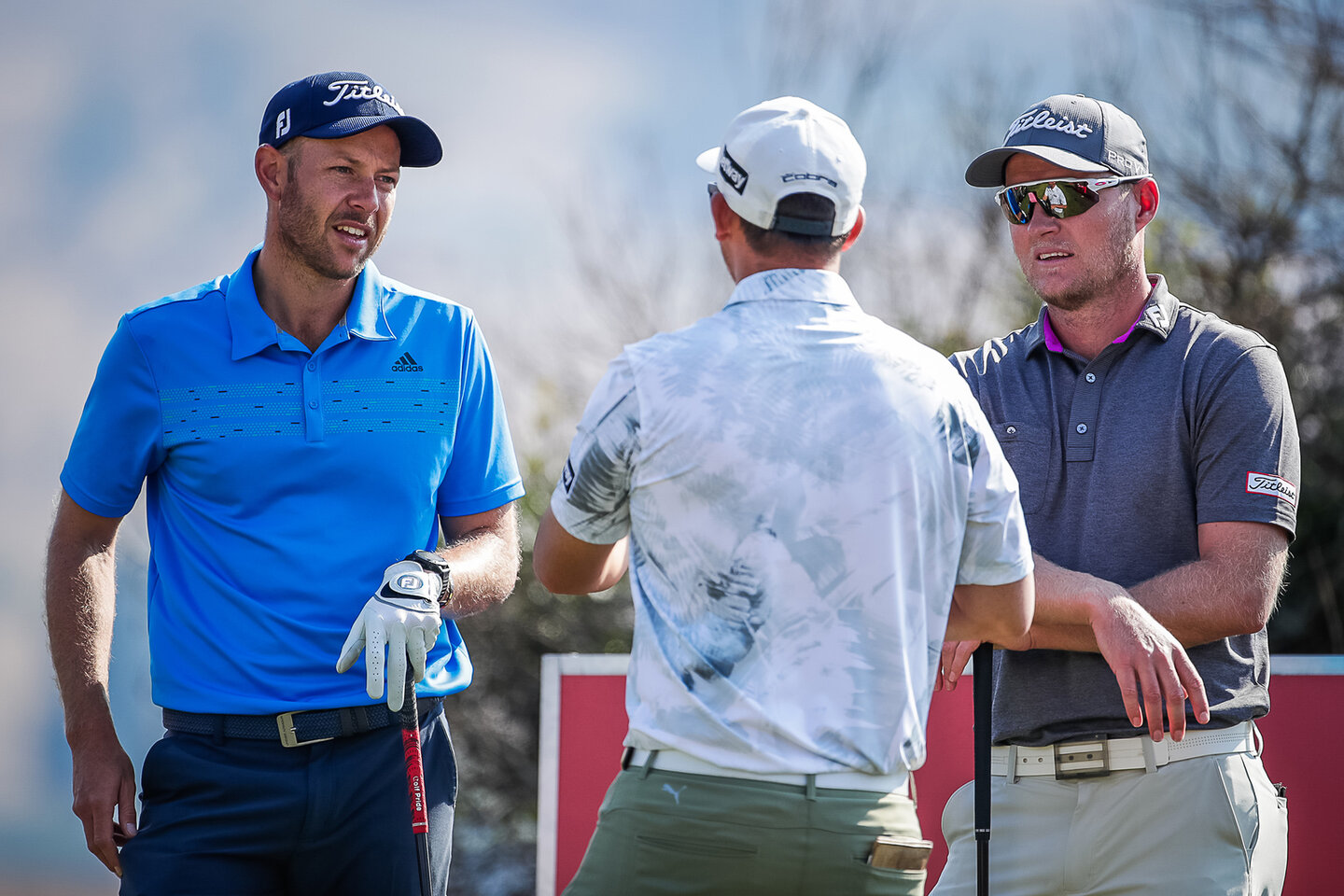
If someone around you is calm, grounded and steady, your system settles. If someone is tense, frustrated, or erratic, your system tightens – often without you noticing. This process is called co-regulation. And it happens on the golf course all the time.
WHY THIS MATTERS
What separates rounds is often not just technical skill, but who manages their state best – and who can steady it when it starts to drift.
Most golfers have the ability to hit decent shots – but it's about whether these shots show up consistently under different conditions. When your system is settled, your swing tends to organise itself. Your timing is better, your decisions are clearer, and you trust what you're doing. But as your state shifts things can start to unravel, your tempo quickens, you guide the ball instead of swinging freely. You start reacting rather than committing.
The important point is this: nothing fundamental about your ability and skill has changed. But your access to that ability has.
That's why golfers often walk off thinking, 'I know I'm better than that.'
Once you understand this, the game changes slightly. It's no longer just about fixing your swing. It's about recognising when your state is shifting – and having the ability to steady it before it costs you shots.
LESSONS FROM THE TOP
At the professional level, this is often most visible through the relationship between player and caddie.
When a young golfer recently won on the Sunshine Tour, there was a noticeable moment late in the round: nerves were showing, tension creeping into his game. But his caddie stayed calm, grounded, and steady. You could almost see the effect. The player didn't just receive advice; he borrowed composure.
This idea isn't limited to golf.
In a TED Talk, endurance swimmer Lewis Pugh described preparing to swim in testing Arctic conditions. In a moment of doubt, it wasn't a technique or a strategy that steadied him. It was a speech from a close friend. The words didn't change the conditions, but they changed his state.

GOLF IS GOOD FOR CO-ORDINATION
Golf can be a challenge because the ball is small and the ground gets in the way. But the practice of hitting a ball with a golf club is excellent for developing coordination. You have to turn the body, swing the arms, shift your weight with your legs, and make contact with the ball – all at the same time.
As that movement becomes more and more familiar, your co-ordination improves. As with all skills, it takes practice. The more you swing the club, the quicker it will be that you move in balance and send the ball sailing away.
However, there are also other fun ways to improve your co-ordination with a golf club and ball – check out this Facebook Reel from GolfRSA’s account and see how much fun practicing your coordination can be in golf.
WHAT TO DO WHEN THINGS SLIP
Most golfers know the feeling of a round drifting away. Things are going well… and then something shifts. The question is: what do you do when you feel that shift happening?
The first step is simple, but not easy – notice it early.
Notice when your tempo starts to quicken, when your thoughts become more cluttered. When frustration lingers a little longer than it should. That awareness creates a small but important gap.
From there, the goal is to stabilise yourself.
That might look like:
- Slowing your walk between shots
- Taking one steady breath before you address the ball
- Narrowing your focus back to the next shot, not the score
And if the group around you feels tense or rushed, this becomes even more important. You may not be able to change them – but you can stop yourself from being pulled along with that energy. In fact, you want to become the calm in the group. So instead of only asking, 'How do I hold it together?', a more powerful question is: 'How can I bring a steadier presence to this group?'
FINAL ENCOURAGEMENT
Golf is never played in isolation. Every round becomes, in some way, a shared nervous system. And once you begin to see that something shifts.
You realise the difference in your game isn't only in your swing.
It's in who you're playing with … and just as importantly, who you choose to be within that group.
About the author
Gavin Groves graduated in biokinetics from the University of Pretoria in 2007 and started working as a golf fitness professional at the World of Golf. A year later, he started his journey with the Titleist Performance Institute. He is also an AA-member of the PGA of South Africa. He joined the University of Pretoria's High Performance golf programme in 2013. In 2018, he moved to the DP World Tour, while he also counts numerous past and present Sunshine Tour professionals as clients. He has been the full-time fitness consultant of the GolfRSA National Squad since 2017 and worked with some of the best SA amateur golfers.
Gavin Groves graduated in biokinetics from the University of Pretoria in 2007 and started working as a golf fitness professional at the World of Golf. A year later, he started his journey with the Titleist Performance Institute. He is also an AA-member of the PGA of South Africa. He joined the University of Pretoria's High Performance golf
Gavin Groves graduated in biokinetics from the University of Pretoria in 2007 and started working as a golf fitness professional at the World of Golf.
A year later, he started his journey with the Titleist Performance Institute. He is also an AA-member of the PGA of South Africa. He joined the University of Pretoria's High Performance golf
programme in 2013. In 2018, he moved to the DP World Tour, while he also counts numerous past and present Sunshine Tour professionals as clients. He has been the full-time fitness consultant of the GolfRSA National Squad since 2017 and worked with some of the best SA amateur golfers.
About the author
Dr Kirsten van Heerden represented South Africa at swimming and holds a PhD in sport psychology. She has worked and travelled extensively within high performance sport for more than 15 years. She has authored a book, Waking From the Dream, on the challenges athletes face when they retire from elite sport. In her podcast ‘Behind the Dream’ she talks with some of the world’s best athletes about the ups and downs of being a professional athlete. She is also the founder and chairperson of Girls Only Project – a non-profit company focusing on women in sport issues. She is in private practice at Newton Sports Agency.




About the author
Dr Kirsten van Heerden represented South Africa at swimming and holds a PhD in sport psychology. She has worked and travelled extensively within high performance sport for more than 15 years.She has authored a book, Waking From the Dream, on the challenges athletes face when they retire from elite sport. In her podcast ‘Behind the Dream’ she talks with some of the world’s best athletes about the ups and downs of being a professional athlete. She is also the founder and chairperson of Girls Only Project – a non-profit company focusing on women in sport issues. She is in private practice at Newton Sports Agency.
Dr Kirsten van Heerden represented South Africa at swimming and holds a PhD in sport psychology. She has worked and travelled extensively within high performance
sport for more than 15 years.She has authored a book, Waking From the Dream, on the challenges athletes face when they retire from elite sport. In her podcast ‘Behind the Dream’ she talks with some of the world’s best athletes about the ups and downs of being a professional athlete. She is also the founder and chairperson of Girls Only Project – a non-profit company focusing on women in sport issues. She is in private practice at Newton Sports Agency.

TYRONE WINFIELD | SHAUN ROY | SUNSHINE TOUR